In computing effective dose an hermaphrodite mathematical model has been
used. It was derived from the male phantom developed for MCNP by
GSF-Forschungszentrum für Umwelt und Gesundheit
(Germany) [21]. The MCNP
phantom was translated in terms of bodies and regions appropriate for the
combinatorial geometry of FLUKA. Then the female organs (breast, ovaries and
uterus) were added. The various organs and tissues of human body have been
represented by 68 regions. Internal organs have been considered to be
homogenous in composition and density. The composition was limited to the
14 elements: H, C, N, O, Na, Mg, P, S, Cl, K, Ca, Fe, Zr and Pb. Different
densities have been used for the lungs (0.296
 ), bone
(1.486
), red marrow (1.028
), soft
tissue (0.987
) and skin (1.105
).
), bone
(1.486
), red marrow (1.028
), soft
tissue (0.987
) and skin (1.105
).
Calculations of effective dose have been carried out on the basis of
equation 3 using the radiation weighting factors shown in table
1. For charged pions and kaons the approximation given by
eq. 2 was used. If one is willing to adopt other  values,
the calculated data (
values,
the calculated data ( calculated following eq. 4) should be
scaled with respect to the
calculated following eq. 4) should be
scaled with respect to the  used.
used.
Concerning the tissue weighting factors ,
values shown in table 3 were used and the so called
``remainder dose'' has been evaluated from the doses to nine additional
individual organs and tissues as arithmetic mean. In the present
calculations, the dose to a given organ or tissue spread throughout the
whole body and represented in the mathematical model by several regions
(for instance skin, bone, red bone marrow, muscle ...). has been determined
as arithmetic mean of the doses received in the single constituent
regions. According to ICRP Publication 67 the higher value of doses to the
ovaries and testes was applied to the gonad weighting factor. The dose to
muscles has been assumed as the arithmetic mean of the doses received by
the part of the body volume which is not attributed to any other organ or
tissue.
Calculations were performed for fully isotropic radiation incidence (obtained by the use of an inward-directed, biased cosine source on a spherical surface), from semi-isotropic (from the top) radiation source and with broad parallel beams with the following directions of incidence: antero-posterior, postero-anterior, right lateral, from the top and from the bottom. The medium between the source and the phantom was assumed to be vacuum.
The energy per primary incident particle deposited in the regions representing the various organs and tissues has been determined by use of MonteCarlo simulations.
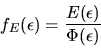
Once the effective dose ( ) as a function of particle energy for
various kinds
of radiation was computed,
the fluence-to-effective dose conversion coefficients (
) as a function of particle energy for
various kinds
of radiation was computed,
the fluence-to-effective dose conversion coefficients ( ) were
calculated in
terms of effective dose per unit of fluence (
) were
calculated in
terms of effective dose per unit of fluence ( ):
):
where
 is the fluence of primary particle of energy
  .
.
Calculation results are presented in section 4.