There are two types of quantities defined for use in radiological protection: protection quantities (defined by the ICRP and used for assessing the exposure limits) and operational quantities (defined by the ICRU and intended to provide a reasonable estimate for the protection quantities).
The most recent set of protection quantities was recommended in ICRP
Publication 60 [3]: it includes the
tissue or organ equivalent doses ( ) and the effective dose (
 ).
The equivalent dose, , in a tissue or organ,
).
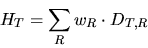
The equivalent dose, , in a tissue or organ,  , is given by:
where  is the average absorbed dose from radiation
  , in tissue
,
, in tissue
,  is the radiation weighting factor for radiation and the sum
is performed through all kind of radiation that constitue the radiation
field considered. Table 1 gives the values of radiation
weighting factors as recommended by ICRP. For radiation types and energies
that are not included in table 1 an approximation to can
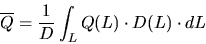
be obtained by the calculation of the average quality factor,
is the radiation weighting factor for radiation and the sum
is performed through all kind of radiation that constitue the radiation
field considered. Table 1 gives the values of radiation
weighting factors as recommended by ICRP. For radiation types and energies
that are not included in table 1 an approximation to can
be obtained by the calculation of the average quality factor,
 , at a depth of 10 mm in the ICRU sphere (for the definition
of the ICRU sphere see section 3.2:
, at a depth of 10 mm in the ICRU sphere (for the definition
of the ICRU sphere see section 3.2:
where  is the absorbed dose at 10 mm between linear energy transfer
values of
is the absorbed dose at 10 mm between linear energy transfer
values of  and
and  and
and  is the corresponding quality
factor. The relation between
is the corresponding quality
factor. The relation between  and (recommended by ICRP 60) is shown
in table 2.
and (recommended by ICRP 60) is shown
in table 2.
| RADIATION | |
| Photons | 1 |
| Electrons and muons | 1 |
| Neutrons: | |
E 10 keV 10 keV |
5 |
|
10 keVE100 keV |
10 |
|
100 keVE2 MeV |
20 |
|
2 MeVE20 MeV |
10 |
E 20 MeV 20 MeV |
5 |
|
Protons, other than recoil protons (E2 MeV) |
5 |
 particles, fission fragments, heavy nuclei particles, fission fragments, heavy nuclei |
20 |
|
in water |
|
keV/ m m |
(with in keV/m) |
|
10 |
1 |
10 100 100 |
0.32  2.2 2.2 |
|
100 |
 |
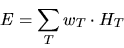
The effective dose is the sum of the weighted equivalent doses in all
the tissues and organs of the body. It is given by the expression:
where is the equivalent dose in tissue or organ ,  is the
weighting factor for tissue and the sum is performed on all tissue and
organs involved in irradiation. Table 3 gives the values of
tissue weighting factors as recommended by ICRP.
is the
weighting factor for tissue and the sum is performed on all tissue and
organs involved in irradiation. Table 3 gives the values of
tissue weighting factors as recommended by ICRP.
| TISSUE or ORGAN | |
| Gonads | 0.20 |
| Red bone marrow, Colon, Lung, Stomach | 0.12 |
| Bladder, Breast, Liver, Oesophagus, Thyroid | 0.05 |
| Bone surface, Skin | 0.01 |
| Remainder | 0.05 |
The protection quantities and are not directly
measurable [4], but
may be related by calculation to the radiation field if the condition or
irradiation are known. The only way to estimate and is to measure
the radiation field outside the body and to convert it to and
using previously calculated conversion coefficients.
The mean absorbed dose is a quantity that cannot be evaluated
experimentally, therefore operational quantities [5] (defined in
terms of the
quality factor ) should be used. The operational quantities are intended
to provide a reasonable estimate of the protection quantities, the goal is
that the value of the appropriate protection quantity is less than that of
the corresponding operational quantity.
For strongly penetrating radiation the appropriate operational quantity for
area monitoring is ambient dose equivalent. The ambient dose equivalent
 at a point in a radiation field is the dose equivalent that would
be produced by the corresponding expanded and aligned field in the ICRU
sphere at a depth
at a point in a radiation field is the dose equivalent that would
be produced by the corresponding expanded and aligned field in the ICRU
sphere at a depth  , on the radius opposing the direction of the aligned
field. The recommended value of for penetrating radiation is 10 mm. The
dose equivalent at other depths may be considered when the dose equivalent
at 10 mm provides an unacceptable underestimate of the effective dose.
, on the radius opposing the direction of the aligned
field. The recommended value of for penetrating radiation is 10 mm. The
dose equivalent at other depths may be considered when the dose equivalent
at 10 mm provides an unacceptable underestimate of the effective dose.