|
 |
| Main AEgIS website
http://aegis.web.cern.ch/aegis/ |
| |
|
|
| |
| INTRODUCTION |
| General
relativity and quantum mechanics are two of the very
foundations of modern physics. Yet, as waspointed out early on
by Wigner
[1], the two
are to some degree incompatible. The most obvious discrepancy
is the dynamic spacetime geometry of general relativity, which
clashes with the fixed-background approach of quantum field
theory. In order to repair some of these perceived
contradictions and to properly incorporate gravity into the
Standard Model, some scientists actively pursue a unification
of gravity with the other fundamental interactions within what
has been called a ‘‘Theory of Everything”
[2].
|
| A
hypothetical quantum theory of gravitation necessarily constitutes a departure
from the Einsteinian view of gravity as a geometric phenomenon. As in other
quantum field theories, the interaction is mediated by exchange particles. The
spins of these exchange bosons as well as the signs of the charges to which
they couple determine whether a force is repulsive or attractive. Generally
speaking, evenspin particles create an attractive force between all types of
charges, whereas the exchange of odd-spin particles leads to a repulsive force
between like charges. Hence, the formulation of a quantum theory of gravitation
automatically brings about the possibility of different types of exchange
particles as well as negative mass charge. Attempts at formulating a quantum
gravity have mainly been hampered by the fact that such a theory is
non-renormalizable, though a renormalization within the framework of an
effective field theory may turn out to be feasible
[3]. |
| When
constructing such a theory, ordinary ‘‘Newtonian” gravity is associated with a
massless tensor (spin-2) exchange boson, as the force has an infinite range and
is always attractive. In addition to this tensor part, gravity could have
scalar (spin-0) and/or vector (spin-1) components. Unlike the tensor and scalar
parts, a vector component would lead to a repulsive force acting between like
charges. Such a force would thus produce a dramatic effect on antimatter
particles in the Earth’s gravitational field and constitute a violation of the
weak equivalence principle (also called the universality of free fall).
|
There are
a number of arguments against ‘‘anti-gravity,” i.e. a tensor-type gravitational
interaction with opposite sign for antimatter
[4–7].
The most intuitive of these is Morrison’s argument
[8],
which elegantly demonstrates that such a phenomenon would violate conservation
of energy. Quantitative limits on possible anti-tensor gravity effects can be
obtained, among others, from estimates of the effects of virtual antiparticles
in ordinary matter
[9,10] or the
absence of changes in the cyclotron frequency of antiprotons ( ) confined in a Penning
trap [11]. Most, if not all, of these arguments do not
apply to more elaborate models involving vector and scalar gravitons. If the
hypothetical vector and scalar charges, as well as their masses (and thus the
ranges of the interactions) are carefully chosen, such contributions can be
strongly suppressed in ordinary matter. Finally, it should be stated that the
problem of the gravitational interaction of antimatter is completely
independent from the – equally fascinating – question of matter–antimatter
symmetry (CPT), as CPT invariance merely dictates the equality of the inertial
masses of particle and antiparticle pairs, but places no restriction on the
gravitational masses. ) confined in a Penning
trap [11]. Most, if not all, of these arguments do not
apply to more elaborate models involving vector and scalar gravitons. If the
hypothetical vector and scalar charges, as well as their masses (and thus the
ranges of the interactions) are carefully chosen, such contributions can be
strongly suppressed in ordinary matter. Finally, it should be stated that the
problem of the gravitational interaction of antimatter is completely
independent from the – equally fascinating – question of matter–antimatter
symmetry (CPT), as CPT invariance merely dictates the equality of the inertial
masses of particle and antiparticle pairs, but places no restriction on the
gravitational masses. |
Unlike
ordinary matter
[12], the
behavior of antimatter particles in a gravitational field has never been tested
experimentally. Two attempts, at Stanford
[13] and
CERN’s Low-Energy Antiproton Ring
[14] were
thwarted by the overwhelming effect of stray electric and magnetic fields upon
the electrically charged test particles. The recent production of copious
amounts of cold antihydrogen ( ) at CERN’s Antiproton
Decelerator (AD)
[15,16] has paved
the way for high-precision gravity experiments with neutral antimatter. We have
proposed the AEGIS experiment (Antimatter Experiment: Gravity, Interferometry,
Spectroscopy), to be performed at CERN/AD, in order to address this important
question. ) at CERN’s Antiproton
Decelerator (AD)
[15,16] has paved
the way for high-precision gravity experiments with neutral antimatter. We have
proposed the AEGIS experiment (Antimatter Experiment: Gravity, Interferometry,
Spectroscopy), to be performed at CERN/AD, in order to address this important
question. |
The
primary scientific goal of AEGIS is the direct measurement of the Earth’s local
gravitational acceleration
 on
. In a first phase of the
experiment, a gravity measurement with on
. In a first phase of the
experiment, a gravity measurement with
 relative precision will
be carried out by observing the vertical displacement of the shadow image
produced by an
beam as it traverses a
Moiré deflectometer, the classical counterpart of a matter wave interferometer.
In spite of its limited precision, this measurement will represent the first
direct determination of the gravitational effect on antimatter. relative precision will
be carried out by observing the vertical displacement of the shadow image
produced by an
beam as it traverses a
Moiré deflectometer, the classical counterpart of a matter wave interferometer.
In spite of its limited precision, this measurement will represent the first
direct determination of the gravitational effect on antimatter. |
|
The
essential steps leading to the production of
and the measurement of
with AEGIS are the
following:
The
feasibility of the first two points has been conclusively demonstrated by the
ATHENA and ATRAP collaborations (see, in particular,
[17,18]).
In the following, we will discuss the remaining aspects of the proposed
technique in more detail.
|
|
|
While
some
 are lost due to so-called
pick-off annihilations of are lost due to so-called
pick-off annihilations of
 with the molecular with the molecular
 of the cavity walls, a
sizable fraction diffuses out of the film at thermal energies. The overall
yield as well as the
final velocity distribution depend upon the characteristics of the target
material (in particular, its pore structure), the implantation depth, and the
target temperature. Measurements using positron annihilation lifetime
spectroscopy have shown that the
fraction (outside the
sample) can reach of the cavity walls, a
sizable fraction diffuses out of the film at thermal energies. The overall
yield as well as the
final velocity distribution depend upon the characteristics of the target
material (in particular, its pore structure), the implantation depth, and the
target temperature. Measurements using positron annihilation lifetime
spectroscopy have shown that the
fraction (outside the
sample) can reach
 in silicon-based polymer
materials cooled to in silicon-based polymer
materials cooled to
 [20].
In other experimental work, it was shown that the energy profile of [20].
In other experimental work, it was shown that the energy profile of
 emitted from the surface
of a silica film at room temperature followed a Maxwell–Boltzmann distribution
and was compatible with the Ps being fully thermalized
[21].
We are currently conducting experiments in order to determine the optimal
converter material and
energy in
terms of
yield. Furthermore, we
are investigating how well the emitted Ps is thermalized at very low target
temperatures. emitted from the surface
of a silica film at room temperature followed a Maxwell–Boltzmann distribution
and was compatible with the Ps being fully thermalized
[21].
We are currently conducting experiments in order to determine the optimal
converter material and
energy in
terms of
yield. Furthermore, we
are investigating how well the emitted Ps is thermalized at very low target
temperatures. |
The
photo-excitation of
to Rydberg states
requires photon energies close to the binding energy of
 . Laser systems at the
corresponding wavelengths ( . Laser systems at the
corresponding wavelengths ( ) are not commercially
available. We are therefore planning to perform a two-step excitation, from the
ground state to the ) are not commercially
available. We are therefore planning to perform a two-step excitation, from the
ground state to the
 state ( state ( ), and then to the ), and then to the
 Rydberg band ( Rydberg band ( ). Two pulsed-laser
systems, both of which are pumped by a Q-switched Nd:YAG laser ( ). Two pulsed-laser
systems, both of which are pumped by a Q-switched Nd:YAG laser ( ), are currently under
development. Both systems must provide sufficient power to excite the emitted
within a few ), are currently under
development. Both systems must provide sufficient power to excite the emitted
within a few
 and must be geometrically
matched to the expanding cloud. Furthermore, the bandwidths of the lasers must
be tailored to the transition linewidth broadened due to the Doppler effect as
well as level splitting due to the motional Stark effect and the linear and
quadratic Zeeman effect (the latter three creating the Rydberg band). and must be geometrically
matched to the expanding cloud. Furthermore, the bandwidths of the lasers must
be tailored to the transition linewidth broadened due to the Doppler effect as
well as level splitting due to the motional Stark effect and the linear and
quadratic Zeeman effect (the latter three creating the Rydberg band).
|
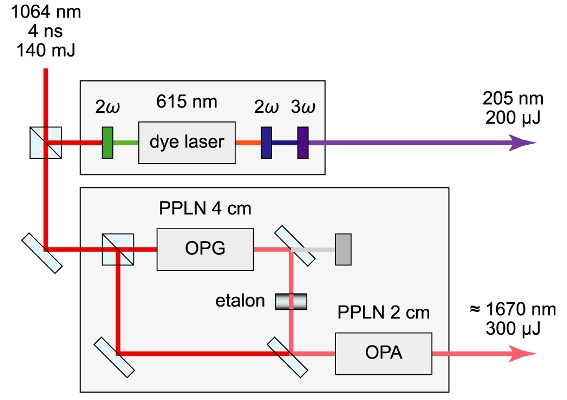
An
overview sketch of the planned laser setup is shown in
Fig. 1.
The first system is a dye laser whose optical cavity uses prisms as selective
elements in order to produce the large bandwidth required. After up-conversion
with a succession of second and third harmonic crystals, the laser will produce
 radiation with pulse
energies of radiation with pulse
energies of
 . The second system
combines an optical parametric generator with an amplification stage, both of
which make use of commercially available periodically poled crystals (i.e.
materials with birefringent layers in alternating orientation). In these
non-linear media, the pump photons are down-converted to an idler and a signal
photon (signal wavelength . The second system
combines an optical parametric generator with an amplification stage, both of
which make use of commercially available periodically poled crystals (i.e.
materials with birefringent layers in alternating orientation). In these
non-linear media, the pump photons are down-converted to an idler and a signal
photon (signal wavelength
 , pulse energy , pulse energy
 ). The wavelengths can be
precisely controlled by adjusting the crystal
temperature. Due to the broad bandwidth, the coherence time of the second
system will be several orders of magnitude shorter than the pulse length.
Nevertheless, excitation fractions in the Rydberg band of
or higher can be
expected. ). The wavelengths can be
precisely controlled by adjusting the crystal
temperature. Due to the broad bandwidth, the coherence time of the second
system will be several orders of magnitude shorter than the pulse length.
Nevertheless, excitation fractions in the Rydberg band of
or higher can be
expected. |
|
|
|
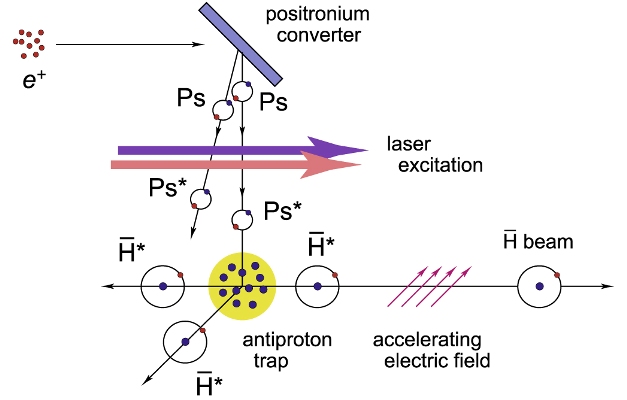
Fig. 2.
Proposed
method for
 recombination and subsequent
acceleration. recombination and subsequent
acceleration.
|
|
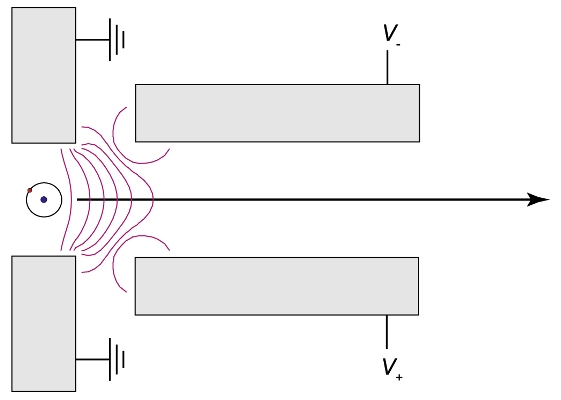
Fig. 3.
Electrode geometry and resulting equipotential lines
(magenta) as employed for Stark acceleration of Rydberg
atoms. |
|
|
| While
neutral atoms are not sensitive (to first order) to constant electric fields,
they do experience a force when their electric dipole moment is exposed to an
electric-field gradient. Since the dipole moment scales approximately with the
square of the principal quantum number, Rydberg atoms are especially amenable
to being manipulated in this way. This technique is related to the splitting of
spectral lines due to the presence of external electric fields (the Stark
effect) and is therefore called Stark acceleration. |
Recently,
Stark acceleration has been successfully demonstrated by one of the AEGIS
groups with (ordinary) hydrogen after excitation to the
 states
[28,29].
In these experiments, accelerations of states
[28,29].
In these experiments, accelerations of
 were achieved using the
electrode geometry shown in
Fig. 3. A
hydrogen beam traveling at were achieved using the
electrode geometry shown in
Fig. 3. A
hydrogen beam traveling at
 was stopped within was stopped within
 over a distance of only over a distance of only
 . We intend to
use a similar electrode configuration, adapted to the cylindrical geometry of a
Penning trap, to accelerate the created
atoms to about . We intend to
use a similar electrode configuration, adapted to the cylindrical geometry of a
Penning trap, to accelerate the created
atoms to about
 in the direction of the deflectometer
apparatus. Prior to the beam formation, remaining
can be transferred back to the
accumulation trap in order to be reused in the next cycle. in the direction of the deflectometer
apparatus. Prior to the beam formation, remaining
can be transferred back to the
accumulation trap in order to be reused in the next cycle. |
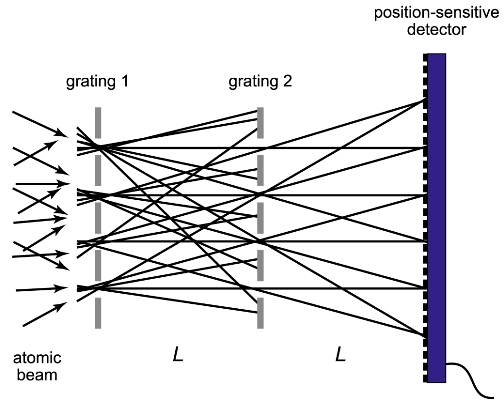
Fig. 4.
Principle sketch of the Moiré deflectometry technique with two
identical gratings and a position-sensitive detector. |
Unlike
atomic fountain interferometers, such a device does not necessit a te trapped
atoms. Furthermore, neither spatial nor temporal coherence of the incoming
particle beam are required. Due to these unique features, an antimatter gravity
experiment based on a Mach–Zehnder interferometer was proposed some ten years
ago [32]. However, interactions between (anti)-matter
waves and material gratings can lead to a number of decoherence effects in
matter wave diffraction: quenching of metastable states; deflection of Rydberg
states in field gradients; transitions between sub-levels of Rydberg states;
and annihilation of antiatoms on the grating. Furthermore, the technique places
a very stringent limit on the acceptable beam divergence, which must be smaller
than the diffraction angle
 , where , where
 is the de Broglie
wavelength of the matter wave. All of these limitations can be alleviated by
increasing the grating period relative to the de Broglie wavelength. At the
point where is the de Broglie
wavelength of the matter wave. All of these limitations can be alleviated by
increasing the grating period relative to the de Broglie wavelength. At the
point where
 ,
diffraction no longer occurs. ,
diffraction no longer occurs. |
The
resulting device is the so-called Moiré deflectometer, in which diffraction on
the gratings is replaced by a (classical) shadow pattern of those particles
that converge onto the third grating. Interestingly, the gross characteristics
of the interferometer are retained
[33],
in particular, the vertical displacement of the interference pattern according
to Eq. (2). A three-grating Moiré deflectometer has
been used to measure the local gravitational acceleration to a relative
precision of
 with a beam of argon
atoms traveling at an average velocity of with a beam of argon
atoms traveling at an average velocity of
 [33].
In departing from the three-grating deflectometer, we intend to replace the
third grating by a position-sensitive silicon strip detector (see
Fig.
4). Thereby the overall transmission of the apparatus is increased
by the inverse of the grid’s open fraction (roughly a factor of three). [33].
In departing from the three-grating deflectometer, we intend to replace the
third grating by a position-sensitive silicon strip detector (see
Fig.
4). Thereby the overall transmission of the apparatus is increased
by the inverse of the grid’s open fraction (roughly a factor of three).
|
The value
of
 is extracted from the
primary observables (time of flight is extracted from the
primary observables (time of flight
 and vertical displacement
of the fringe pattern and vertical displacement
of the fringe pattern
 ) in the following way, as
illustrated by Monte-Carlo simulations performed by us: First, the ensemble of
all ) in the following way, as
illustrated by Monte-Carlo simulations performed by us: First, the ensemble of
all
 annihilation events on the
detector is plotted as a function of
, as shown in
Fig.
5(a). These events are binned in symmetric classes of annihilation events on the
detector is plotted as a function of
, as shown in
Fig.
5(a). These events are binned in symmetric classes of
 , one of which is shown
shaded in dark blue in the figure. Secondly, the vertical displacement
of the fringe pattern is
extracted for each of the count classes, as illustrated in
Fig.
5(b). Thirdly, the vertical displacement for all count classes is
plotted against the mean time of flight in the class. A
quadratic fit to that graph, as shown in
Fig. 5(c), will
then yield
. In these simulations, a
grating period of , one of which is shown
shaded in dark blue in the figure. Secondly, the vertical displacement
of the fringe pattern is
extracted for each of the count classes, as illustrated in
Fig.
5(b). Thirdly, the vertical displacement for all count classes is
plotted against the mean time of flight in the class. A
quadratic fit to that graph, as shown in
Fig. 5(c), will
then yield
. In these simulations, a
grating period of
 was used, and a finite
detector resolution of was used, and a finite
detector resolution of
 was taken into account. was taken into account.
|
Our
simulations have shown that in order to perform a measurement of
to
relative precision, about
 atoms at a
temperature of atoms at a
temperature of
 will be required. This could be
achieved within about 2–3 weeks of data taking, assuming the AD beam is shared
among four experiments. The grids and detector must be kept precisely aligned
for the entire data taking period, which can be achieved by an auxiliary laser
beam. The zero position of the vertical displacement, (i.e. in the absence of
gravity) is most conveniently obtained by performing a calibration measurement
with the gratings and detector rotated by will be required. This could be
achieved within about 2–3 weeks of data taking, assuming the AD beam is shared
among four experiments. The grids and detector must be kept precisely aligned
for the entire data taking period, which can be achieved by an auxiliary laser
beam. The zero position of the vertical displacement, (i.e. in the absence of
gravity) is most conveniently obtained by performing a calibration measurement
with the gratings and detector rotated by
 about the beam axis. about the beam axis. |
|
|
|
| |
|
This text was taken from the
article
Kellerbauer et al. - AEGIS
Collaboration, Nuclear Instruments and
Methods in Physics Research B 266 (2008) 351-356 –
PDF ,
courtesy AEGIS Collaboration. |
| Update:
A. Kellerbauer
(AEGIS collaboration),
The AEGIS experiment at CERN Measuring the free fall of
Antihydrogen, Hyperfine Interact, 209 (2012) 43 (2012) -
PDF |
| |
| REFERENCES |
|
[1] E.P.
Wigner, Rev. Mod. Phys. 29 (1957) 255, doi:10.1103/
RevModPhys.29.255. |
|
[2] S.
Lem, Dzienniki gwiazdowe, Warsaw, Iskry, 1957. |
|
[3] J.F.
Donoghue, Phys. Rev. D 50 (1994) 3874, doi:10.1103/
PhysRevD.50.3874. |
|
[4] T.E.O.
Ericson, A. Richter, Europhys. Lett. 11 (1990) 295, doi:10.1209/0295-5075/11/4/001. |
|
[5] E.G.
Adelberger et al., Phys. Rev. Lett. 66 (1991) 850, doi:10.1103/
PhysRevLett.66.850. |
|
[6] M.M.
Nieto, T. Goldman, Phys.
Rep. 205 (1991) 221, doi:10.1016/ 0370-1573(91)90138-C. |
|
[7] S. Bellucci, V. Faraoni,
Phys.
Rev. D 49 (1994) 2922, doi:10.1103/
PhysRevD.49.2922. |
|
[8] P.
Morrison, Am. J. Phys. 26 (1958) 358, doi:10.1119/1.1996159. |
|
[9] L.I.
Schiff, Phys. Rev. Lett. 1 (1958) 254, doi:10.1103/
PhysRevLett.1.254. |
|
[10] L.I.
Schiff, Proc. Natl. Acad. Sci. 45 (1959) 69.
<http://www.pnas.org/cgi/reprint/45/1/69>. |
|
[11] R.J.
Hughes, M.H. Holzscheiter, Phys. Rev. Lett. 66 (1991) 854, doi:10.1103/PhysRevLett.66.854. |
|
[12] B.
Heckel et al., Adv. Space Res. 25 (2000) 1225, doi:10.1016/S0273-1177(99)00995-3. |
|
[13] W.M.
Fairbank et al., in: B. Bertotti (Ed.), Proc. Int. School Phys. Enrico Fermi,
Academic Press, New York, 1974, p. 310. |
|
[14] M.H.
Holzscheiter et al., Nucl. Phys.
A 558 (1993) 709c, doi:10.1016/0375-9474(93)90432-W. |
|
[15] M. Amoretti et al., ATHENA
Collaboration, Nature 419 (2002) 456, doi:10.1038/nature01096. |
|
[16] G.
Gabrielse et al., ATRAP Collaboration, Phys. Rev. Lett. 89 (2002) 213401, doi:10.1103/PhysRevLett.89.213401. |
|
[17] L.V.
Jørgensen et al., ATHENA Collaboration, Phys. Rev. Lett. 95 (2005) 025002, doi:10.1103/PhysRevLett.95.025002. |
|
[18] G.
Gabrielse et al., ATRAP Collaboration, Phys. Lett. B 548 (2002) 140, doi:10.1016/S0370-2693(02)02850-2. |
|
[19] D.W.
Gidley, H.-G. Peng, R.S. Vallery, Annu. Rev. Mater. Res. 36 (2006) 49, doi:10.1146/annurev.matsci.36.111904.135144. |
|
[20] C.G.
Fischer, Phys. Rev. B 71 (2005) 180102R, doi:10.1103/
PhysRevB.71.180102. |
|
[21] R.S.
Vallery, P.W. Zitzewitz, D.W. Gidley, Phys. Rev. Lett. 90 (2003) 203402, doi:10.1103/PhysRevLett.90.203402. |
|
[22] M.
Charlton, Phys. Lett. A 143 (1990) 143, doi:10.1016/0375-9601(90)90665-B. |
|
[23] B.I.
Deutch et al., Hyperfine Interact. 76 (1993) 153, doi:10.1007/
BF02316714. |
|
[24] G.
Gabrielse et al., ATRAP Collaboration, Phys. Rev. Lett. 93 (2004) 073401, doi:10.1103/PhysRevLett.93.073401. |
|
[25] N.
Madsen et al., ATHENA Collaboration, Phys. Rev. Lett. 94 (2005) 033403, doi:10.1103/PhysRevLett.94.033403. |
|
[26] E.A.
Hessels, D.M. Homan, M.J. Cavagnero, Phys. Rev. A 57 (1998) 1668, doi:10.1103/PhysRevA.57.1668. |
|
[27] C.H.
Storry et al., ATRAP Collaboration, Phys. Rev. Lett. 93 (2004) 263401, doi:10.1103/PhysRevLett.93.263401. |
|
[28] E.
Vliegen, F. Merkt, J. Phys. B 39 (2006) L241, doi:10.1088/0953-4075/39/11/L03. |
|
[29] E.
Vliegen et al., Phys. Rev. A 76 (2007) 023405, doi:10.1103/PhysRevA.76.023405. |
|
[30] L.
Zehnder, Z. Instrumentenkunde 11 (1891) 275. |
|
[31] L.
Mach, Z. Instrumentenkunde 12 (1892) 89. |
|
[32] T.J.
Phillips, Hyperfine Interact. 109 (1997) 357, doi:10.1023/A:1012686324139. |
|
[33] M.K.
Oberthaler et al., Phys. Rev. A 54 (1996) 3165, doi:10.1103/PhysRevA.54.3165. |
| |
|
webmaster:
Davide
Trezzi |